Image
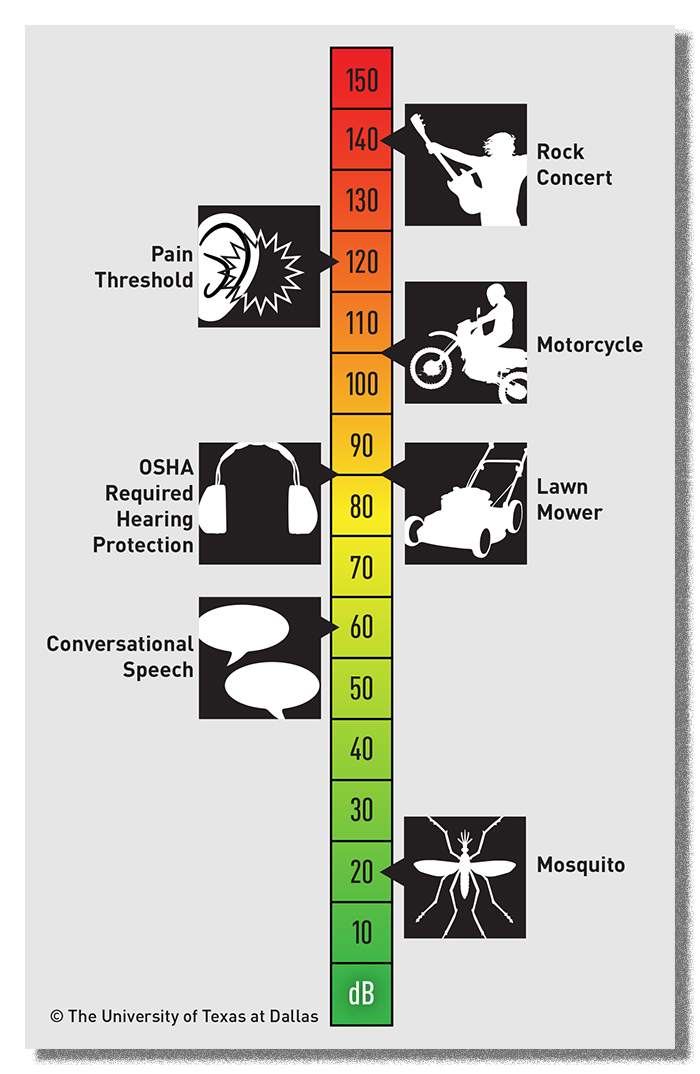
courtesy UT Dallas: Regular exposure to sounds greater than 100
decibels for more than a minute at a time may lead to permanent hearing
loss, according to the National Institute of Deafness and Other
Communication Disorders.
Prolonged exposure to loud noise alters how the brain processes
speech, potentially increasing the difficulty in distinguishing speech
sounds, according to neuroscientists at The University of Texas at
Dallas (UT Dallas). In a paper published in
Ear and Hearing, researchers demonstrated for the first time how noise-induced hearing loss affects the brain’s recognition of speech sounds.
Noise-induced hearing loss (NIHL) reaches all corners of the
population, affecting an estimated 15% of Americans between the ages of
20 and 69, according to the National Institute of Deafness and Other
Communication Disorders (NIDCD).
Exposure to intensely loud sounds leads to permanent damage of the
hair cells, which act as sound receivers in the ear. Once damaged, the
hair cells do not grow back, leading to NIHL.

Michael Kilgard, PhD
“As we have made machines and electronic devices more powerful, the
potential to cause permanent damage has grown tremendously,” says
Michael Kilgard,
PhD, co-author. “Even the smaller MP3 players can reach volume levels
that are highly damaging to the ear in a matter of minutes.”
To simulate two types of noise trauma that clinical populations face,
UT Dallas scientists exposed rats to moderate or intense levels of
noise for an hour. One group heard a high-frequency noise at 115 dB,
inducing moderate hearing loss. A second group heard a low-frequency
noise at 124 dB causing severe hearing loss. For comparison, the
American Speech-Language-Hearing Association (ASHA) lists the maximum
output of an MP3 player or the sound of a chain saw at about 110 dB and
the siren on an emergency vehicle at 120 dB. Regular exposure to sounds
greater than 100 dB for more than a minute at a time may lead to
permanent hearing loss, according to the NIDCD.
Researchers observed how the two types of hearing loss affected
speech sound processing in the rats by recording the neuronal response
in the auditory cortex a month after the noise exposure. The auditory
cortex, one of the main areas that processes sounds in the brain, is
organized on a scale, like a piano. Neurons at one end of the cortex
respond to low-frequency sounds, while other neurons at the opposite end
react to higher frequencies.
In the group with severe hearing loss, less than one-third of the
tested auditory cortex sites that normally respond to sound reacted to
stimulation. In the sites that did respond, there were unusual patterns
of activity. The neurons reacted slower, the sounds had to be louder,
and the neurons responded to frequency ranges narrower than normal.
Additionally, the rats could not tell the speech sounds apart in a
behavioral task they could successfully complete before the hearing
loss.
In the group with moderate hearing loss, the area of the cortex
responding to sounds didn’t change, but the neurons’ reaction did. A
larger area of the auditory cortex responded to low-frequency sounds.
Neurons reacting to high frequencies needed more intense sound
stimulation and responded slower than those in normal hearing animals.
Despite these changes, the rats were still able to discriminate the
speech sounds in a behavioral task.
“Although the ear is critical to hearing, it is just the first step
of many processing stages needed to hold a conversation,” Kilgard says.
“We are beginning to understand how hearing damage alters the brain and
makes it hard to process speech, especially in noisy environments.”
The work was funded through a grant from NIDCD. Other UT Dallas
researchers involved in the study were co-author Margaret Fonde Jonsson,
PhD, Amanda Reed, PhD, Tracy Centanni, PhD, Michael Borland, Chanel
Matney, and Crystal Engineer, PhD.
The Hearing Review featured Dr Kilgard’s earlier work (along
with other colleagues at UT Dallas, including Drs James & Susan
Jerger, Ross Roeser, Emily Tobey, Aage Moller, Linda Thibodeua, George
Gerkin, Jackie Clark, and Anu Sharma) in an
October 2002 article. Other
HR articles related to research by Dr Kilgard can be accessed at:
http://www.hearingreview.com/2013/12/researchers-find-significant-improvement-for-tinnitus-sufferers-with-vns/
http://www.hearingreview.com/2011/01/nih-research-rebooting-the-brain-to-stop-tinnitus/
Source: UT Dallas
- See more at:
http://www.hearingreview.com/2014/08/noise-induced-hearing-loss-alters-brain-responses-speech/#sthash.pUUSNSG1.dpuf
 As we immerse ourselves in summer fun and activities it's important to remember the things that keep us healthy and enjoy all of our summers to come. We covered this topic on our facebook page (Visit us on facebook!) and posted our weekly Florida Time Union article on our practice website. Here's the gist: there are so many things that we don't consider could damage our hearing. It's our goal to provide you with the information you need to keep hearing healthy. What is too loud? How can I gauge a decibel level? What can I do to protect my hearing? We'll be happy to answer these questions for you!